IoT in Agriculture: What Connected Sensors Actually Solve on Farms
Soil moisture, frost alerts, irrigation control, livestock tracking. Here's how IoT works on farms, what connectivity options fit, and what it takes to deploy.
Published
April 14, 2026
Author
Henrik Holen
A vineyard in southern France loses 30% of a harvest to a late frost. The temperature dropped below zero at 3am, nobody was monitoring, and by sunrise the damage was done. A soil moisture sensor and a temperature alert on a phone would have cost less than a single row of vines.
That's the pitch for IoT in agriculture: the cost of not knowing is almost always higher than the cost of a sensor. The agricultural IoT market is valued at $16-18 billion (2025 estimates from Grand View Research, Precedence Research, and others) and growing at 10-12% annually, driven by water scarcity, labor costs, and the economics of precision over guesswork. But "put sensors on your farm" is vague advice. This guide covers what actually works, what connectivity to use, and what the deployment looks like in practice.
What IoT Solves on Farms
Farm IoT isn't one thing. It's a set of specific problems that sensors and automation address. The common thread: replacing manual checks with continuous data from the field.
Soil moisture monitoring. The most deployed agricultural IoT application. Capacitive sensors buried at root depth report moisture levels every 15-30 minutes. Instead of a farmer walking fields and guessing, the data shows which zones need water and which don't. An Idaho potato grower using LoRaWAN soil probes reduced water consumption by 30%.
Automated irrigation. The natural next step from monitoring. When moisture drops below a threshold, the system triggers a pump or opens a valve. Devine Organics, an organic farm in California, deployed LoRaWAN-connected WaterBit sensors across their asparagus fields. First season results: nearly doubled crop yield (800 to 1,500 lbs/acre) and saved 750,000 gallons of water. The system adjusts watering based on real-time soil data rather than a fixed timer.
Frost and temperature alerts. Temperature sensors in the field push an alert to the farmer's phone when readings approach freezing. For vineyards, orchards, and greenhouses, a few hours of warning is the difference between running frost protection equipment and losing a season's crop. Some systems automate the response: temperature drops below 2C, heaters or wind machines turn on.
Greenhouse climate control. Temperature, humidity, CO2, and light levels monitored continuously. Vents, heaters, fans, and shade screens controlled automatically based on sensor readings. Greenhouses are where IoT delivers the most measurable ROI because the controlled environment responds predictably to adjustments.
Water tank and flow monitoring. Ultrasonic level sensors in water tanks report fill levels. Flow sensors on irrigation lines detect leaks or blockages. For farms that rely on bore water or rainwater collection, knowing the tank level remotely avoids the 30-minute drive to check.
Livestock tracking and health. GPS collars on cattle report location and movement patterns. Accelerometer data detects lameness, heat cycles, and calving events. Geofencing sends an alert if animals leave a boundary. New Mexico State University deployed LoRaWAN GPS collars for cattle tracking across desert rangeland where cellular coverage doesn't exist, and secured a USDA grant to scale it across commercial ranches. According to FAO research, early illness detection through activity monitoring can reduce medication use by up to 20% and treatment costs by up to 15%, with intervention possible days before clinical symptoms appear.
Why Farms Need Different Connectivity
Most IoT tutorials assume your device is next to a WiFi router. Farms aren't.
A single wheat field might cover 500 hectares. A cattle station in Australia can span thousands of square kilometers.
There's no cell tower within range, no power outlet to plug into, and the sensor needs to run for years on a battery because nobody's going to walk out to change it every month.
This is where LoRaWAN fits. A single LoRaWAN gateway covers 5-15 km in rural areas (further with line-of-sight over flat farmland). Sensors transmit small data packets using milliwatts of power, giving battery life measured in years rather than weeks. A farm deploys one gateway on a barn roof and covers every field, every water tank, every outbuilding.
The economics work differently too. A LoRaWAN radio module costs around $8-10 (complete ready-to-deploy sensors start around $25-30 from manufacturers like Dragino and RAK Wireless). There's no SIM card and no monthly airtime fee on a private network. Battery life for soil moisture sensors runs 7-10 years. Compare that to cellular IoT (NB-IoT) at $10-12 per module plus $1-5 per device per year in subscriptions. For a deployment of 50+ sensors across a property, LoRaWAN costs a fraction of cellular over the lifetime of the sensors.
For farms with cellular coverage, NB-IoT and LTE-M are alternatives. Higher per-device cost but no gateway infrastructure needed. And for truly remote properties without any terrestrial coverage, satellite IoT (NB-NTN) is becoming practical, though at much higher per-message costs.
What a Farm Deployment Actually Looks Like
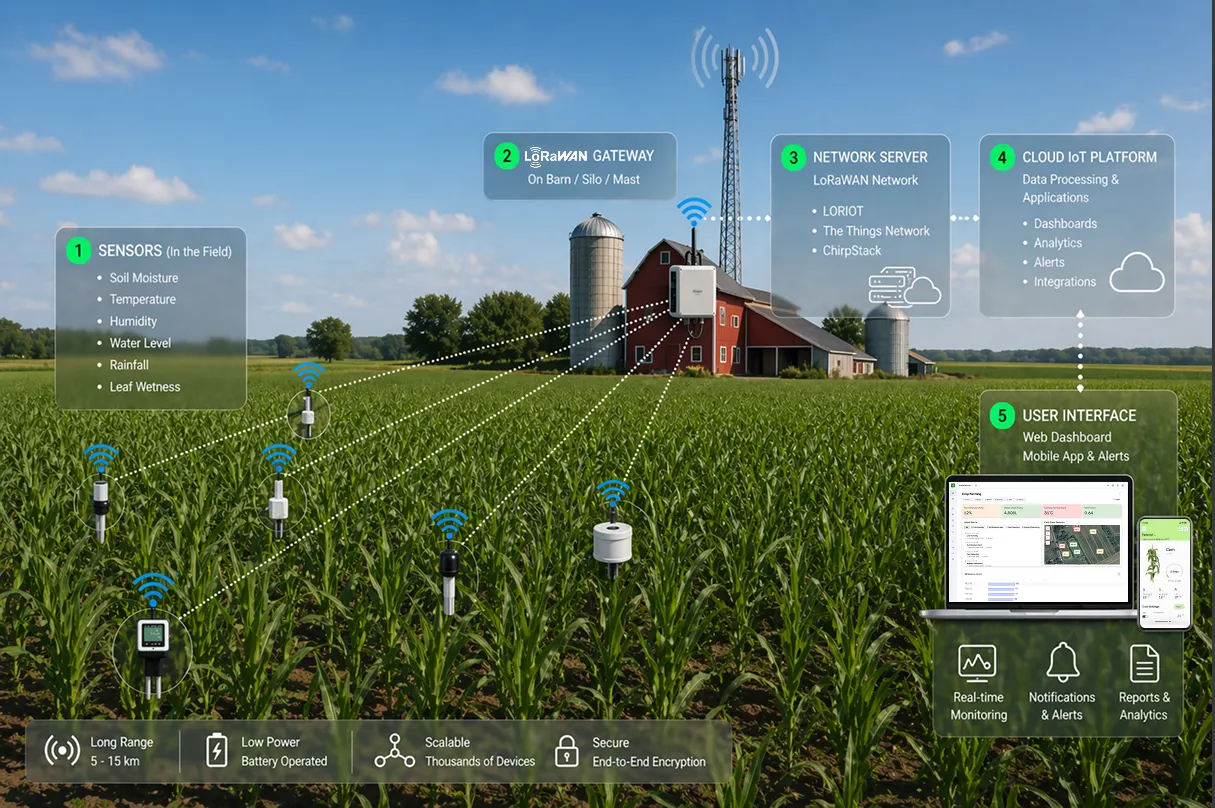
The architecture is simpler than most people expect:
Sensors (soil, temperature, water level, etc.)
→ LoRaWAN radio (5-15 km range, battery-powered)
→ Gateway (on a barn, silo, or mast)
→ Network server (LORIOT, TTN, ChirpStack)
→ Cloud IoT platform (dashboards, mobile app, alerts)
The farmer sees a dashboard on their phone. Soil moisture in field 3 is dropping. Tank 2 is at 40%. The greenhouse is 2 degrees above target. Each of these is a notification they can act on or an automation that acts for them.
Sensor hardware. Most agricultural sensors are purpose-built: waterproof temperature probes (DS18B20), capacitive soil moisture sensors, ultrasonic level sensors for water tanks. For custom builds, an ESP32 with attached sensors handles WiFi-connected farm applications. For LoRaWAN, sensors from manufacturers like Milesight, Tektelic, Seeed Studio, and Dragino come pre-configured for agricultural use cases.
Gateway. A single outdoor LoRaWAN gateway mounted on a high point covers a typical farm. Powered by mains if available, or solar + battery for remote sites. Multiple gateways provide redundancy for larger properties.
Network server. LORIOT, The Things Industries, or ChirpStack handle the LoRaWAN protocol layer: encryption, device management, message routing. They forward clean payloads to your application platform via HTTP or MQTT.
Application platform. This is where sensor data becomes useful. Blynk turns incoming payloads into dashboards, native mobile apps, automations, and alerts. Data Converters parse the LoRaWAN payload format (typically binary or hex-encoded) and map values to named datastreams. The farmer doesn't need to understand data packets. They see "Soil Moisture: 34%" on their phone.
The Use Cases That Work Best
Not every agricultural IoT project delivers value. The ones that work share two characteristics: the data changes the decision, and the cost of the wrong decision is measurable.
Irrigation on water-restricted properties. When water is metered or rationed, every litre matters. Soil moisture sensors prevent both under-watering (crop stress) and over-watering (wasted water, nutrient leaching). Typical water savings: 20-40% depending on crop, climate, and baseline irrigation practices.
Frost protection for high-value crops. A vine, an orchard, or a flower crop can lose an entire season to one frost event. The cost of sensors + alerts is trivial compared to the crop value at risk.
Greenhouse operations. Highest ROI because the environment is controlled and the relationship between sensor readings and actions is direct. Temperature too high? Open vents. Humidity too low? Start misters. CO2 dropping? Adjust ventilation.
Remote water infrastructure. Tanks, pumps, and bores that are far from the homestead. Monitoring levels and flow rates avoids wasted trips and catches failures early (a pump that runs dry, a tank that isn't filling).
Livestock on large properties. GPS tracking reduces mustering time. Movement analysis detects health issues before visual symptoms appear. Most valuable on properties where cattle range over large areas and daily visual inspection isn't practical.
Getting Started
If you're evaluating IoT for an agricultural operation, start with the problem that costs you the most today:
1. Pick one use case. Don't try to instrument the whole farm at once. Soil moisture in the most variable field, temperature in the frost-prone area, or level in the most remote water tank.
2. Pick the connectivity. If you have WiFi at the deployment site, an ESP32 with sensors is the fastest path. If the sensor is 500m or more from any building, LoRaWAN with a gateway is the practical choice. If there's no infrastructure at all, look at satellite.
3. Start with off-the-shelf sensors. Soil moisture probes, temperature probes, and water level sensors are commodity hardware. You don't need custom electronics for a first deployment.
4. Connect to a platform. Get the data onto a dashboard and your phone. Set up one automation (an alert or a pump trigger). See if the data changes how you operate. Then scale from there.
Blynk's IoT cloud platform handles the application layer for agricultural deployments. LoRaWAN sensors connect through network servers like LORIOT. WiFi and cellular sensors connect directly. Data Converters parse any incoming format. The same dashboard works whether you're checking soil moisture from the tractor or reviewing weekly trends from the office.
Blynk is a low-code IoT platform used by 5,000+ businesses to build, deploy, and manage connected products.






.png)